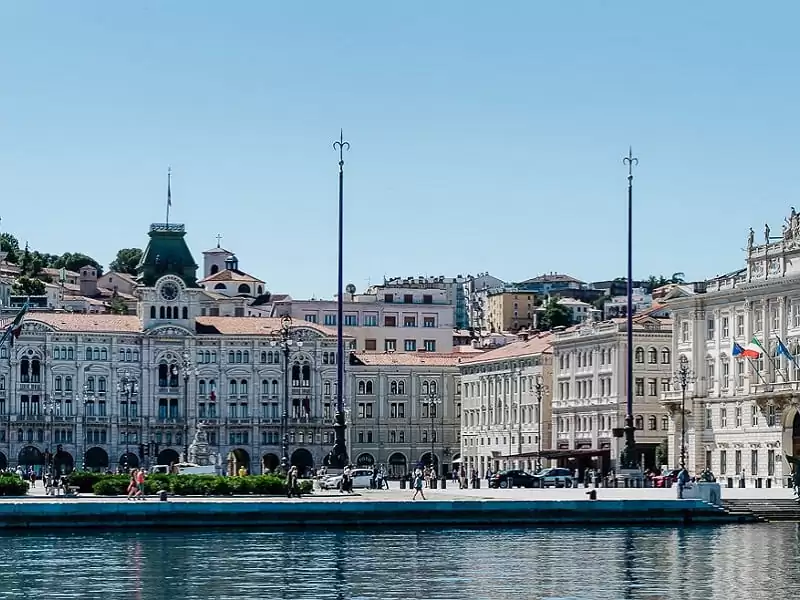
Among seasoned travelers, Trieste is considered a city that can be bypassed. They say it’s out of the way, practically in Slovenia. I don’t understand these people. With the largest seaside square in Europe and a spectacular canal leading to the Adriatic, with architectural eclecticism and a similar mix of cultures, Trieste is certainly not Venice (it’s two hours away by train), but that’s precisely what makes it valuable.
Trieste doesn’t try to board you with resort-like bonhomie or tourist efficiency; on the contrary, it increasingly inclines you towards an existential experience of every moment spent there.
Existential Espresso at Caffè San Marco
A cafe that preserves a centuries-old atmosphere, and an old man who will tell you about Trieste without words.
For example, this colorful eighty-year-old man, whom I’ve been watching for ten minutes at Caffè San Marco. He didn’t just happen to land here for a cup of espresso with grappa and Il Manifesto in his hands; he’s here by providence to embody for me the uniqueness of place and time that you always feel in interesting cities.
And a hundred years ago, he could have sat just like that against the backdrop of this dark wood trim, these golden walls, marble tabletops, and paintings of revelers in carnival masks, reminiscent of Trieste’s unique blend of Venice and Vienna. In the menu of trattorias resembling Tyrolean chalets, pasta and goulash, ravioli and strudel, potato pancakes — frico — and Slovenian soup “jota” with sauerkraut, potatoes, and pork coexist.

Crossroads of Empires
A city that changed hands, and each power left its mark.
Above the surrounding vineyards, reminiscent of Tuscany, onion domes of churches that are anything but Tuscan suddenly appear. This is because Trieste, situated at the junction of Italy and the Balkans for most of its life, was a bargaining chip in territorial agreements. The Venetian Republic seized this former Roman colony in 1202.
101 years later, it declared “voluntary submission” to the Habsburgs and remained part of the Austro-Hungarian Empire until the end of World War I (Vienna clung to Trieste because it was its only seaport), after which it was returned to Italy, but not for long: after the Germans, Marshal Tito was in charge here until 1954.
Svevo, Joyce, and the Bora Wind
Here, great writers found inspiration, and the bora wind grabbed them by the collar.
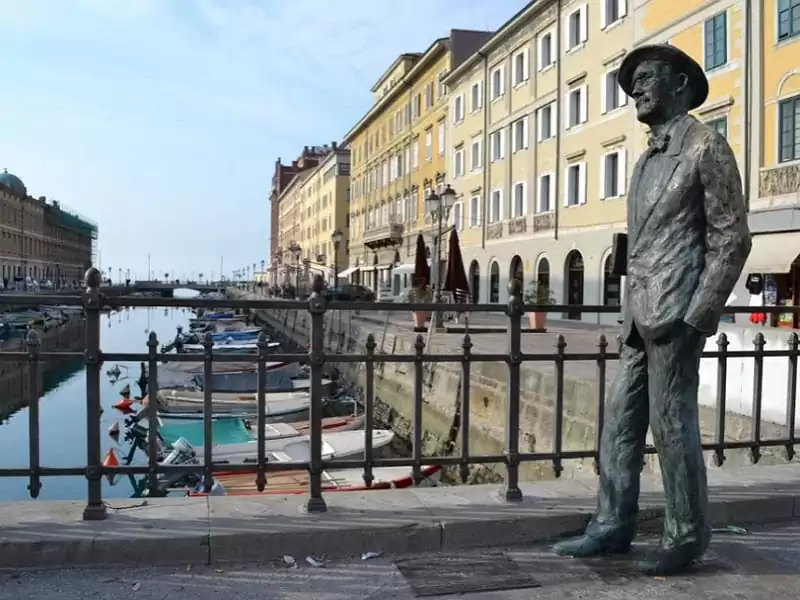
I read all these vicissitudes in the wrinkles of the old man with the newspaper, who could easily have been a character from the books of Italo Svevo, the most famous writer of this city. In his bittersweet novels, characters suffer from love pangs and from the cold northeastern bora wind, which is considered as integral a part of Trieste as double-deckers in London.
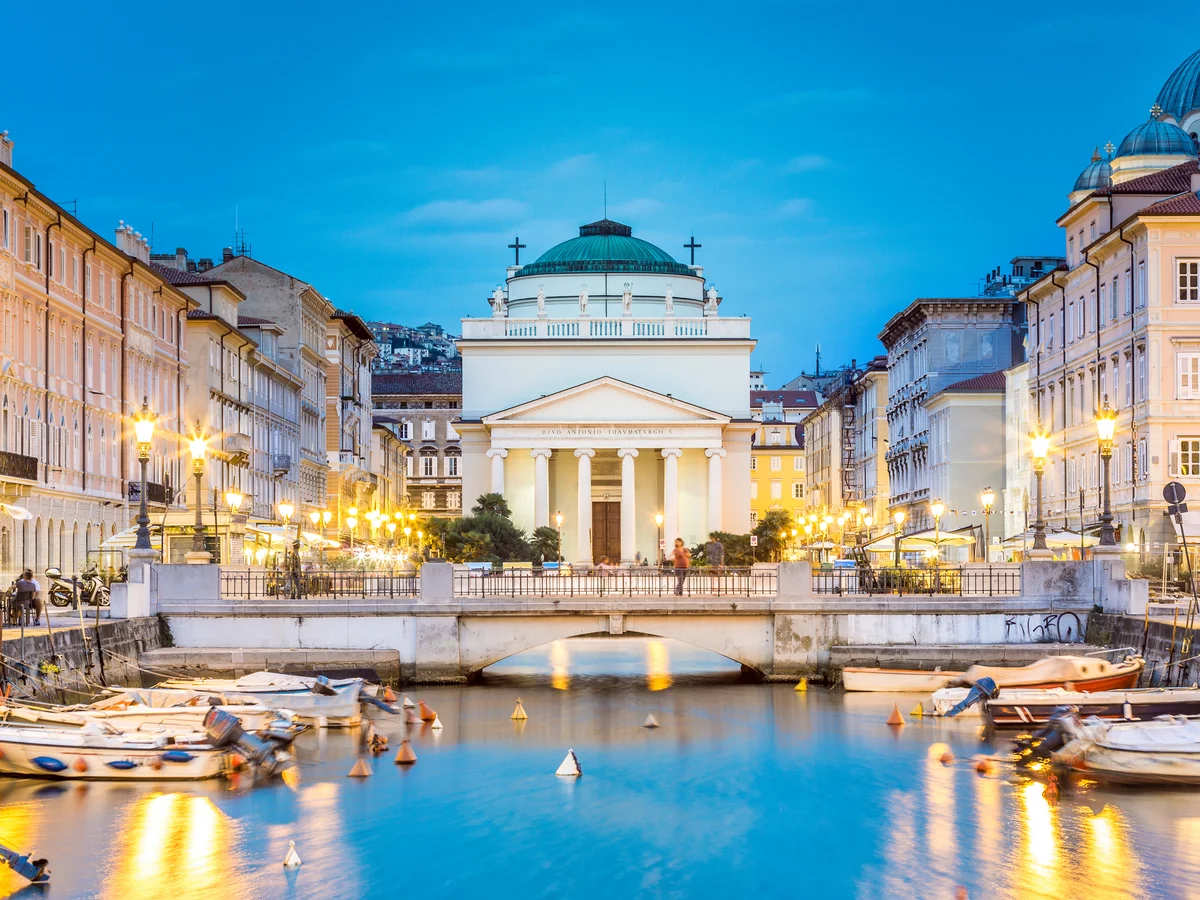
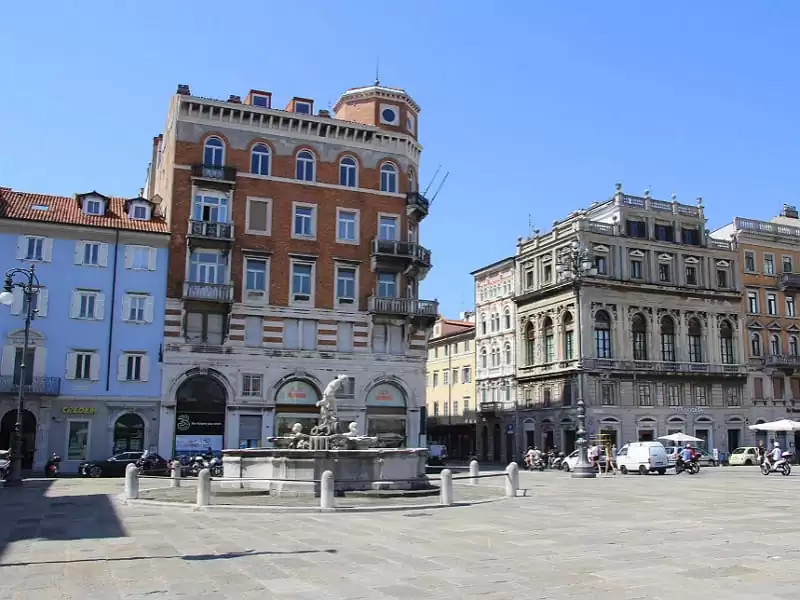
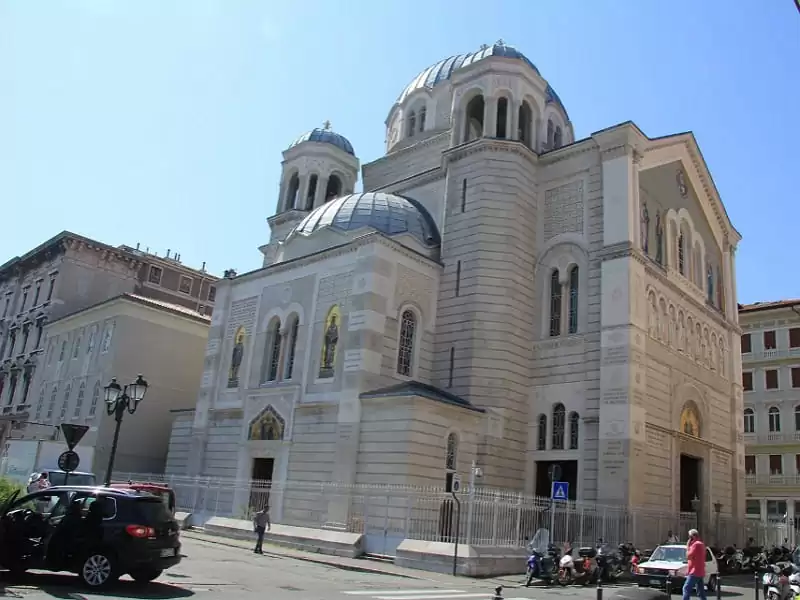
A certain melancholy, thoughtfulness, and universal weariness of off-season Trieste transfer to me as I wander towards the sea from the Church of San Antonio along the Canale Grande, past a Venetian palazzo, past the blue domes of the Serbian Orthodox Church of St. Spyridon, past a small square with colorful houses reminiscent of Ljubljana and Prague simultaneously, to the sound of boats knocking against the piers.
And then I stumble upon a statue of Joyce and find out that he lived here for 11 years and almost starved to death, scraping by with English lessons. Svevo, it turns out, was one of his students.
A City Without a “Mandatory Program”
In Trieste, it’s better not to gallop through sights, but simply to live.
What I like about Trieste is the absence of a list of “star” attractions that cannot be missed. You get to know the city in a relaxed, “optional” manner, and even when visiting museums, most of which are located in old mansions, their setting and architecture are sometimes more interesting than the exhibits themselves.
I realize that I have already used the word “eclectic” in reference to Trieste, but what can I do if it truly is!? Just visit the Revoltella Museum, look at the 19th-century kitsch under titles like “Listening to Beethoven” or “After Communion,” and judge for yourself!
From San Giusto to Orto Lapidario
A climb up the hill, ancient stones, and a garden where cats guard Roman gravestones.
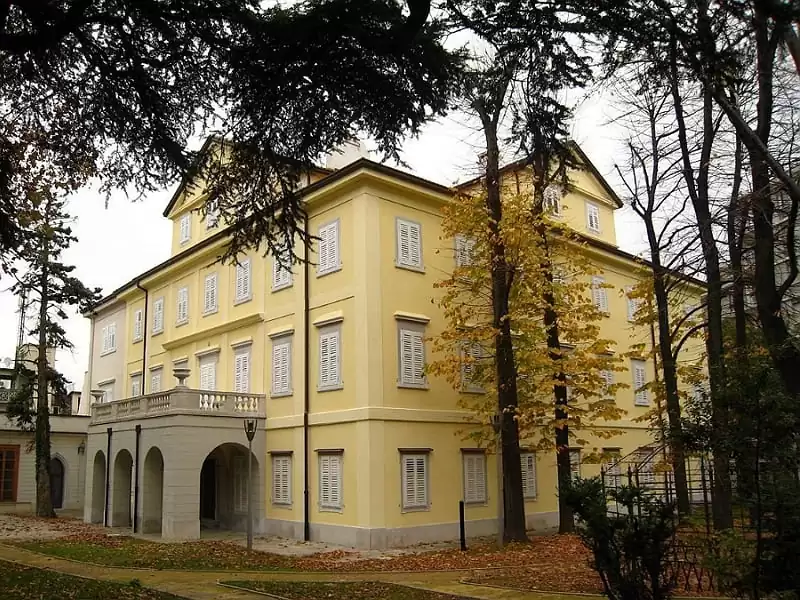
Aimless wandering through the city and cafes came easily to me in Trieste, but on the second day, I drove myself up San Giusto hill to the cathedral with a 12th-century mosaic. Here, Roman busts adorn the Venetian-Byzantine-Gothic facade, and in the courtyard, remnants of Roman basilicas and forums and an unfinished 14th-century castle stand idly by.
The museum will only be interesting to those who rave about armor and plate mail. On the way back down, I stopped by the Museum of History and Art, but not so much for the Egyptian mummies as for a walk among the gravestones and sculptures in the “Orto Lapidario” garden…
Tram No. 2: From the Sea to Carso
A trip from the port to the mountains, caves, and farm feasts with wine and cheese.
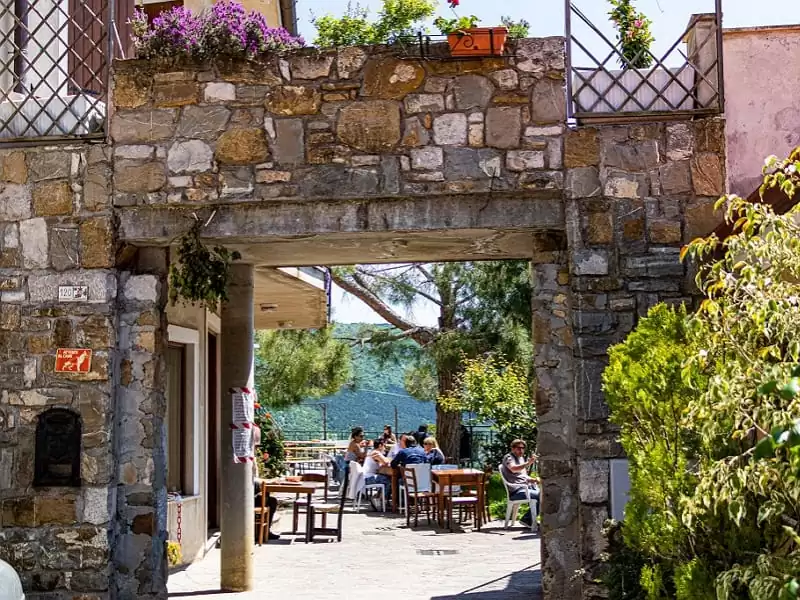
Tired of walking around Trieste, I boarded the old city tram No. 2 at Piazza Oberdan towards Villa Opicina and rode the entire length of the route from the sea to the mountains. Everyone goes to Opicina to see the largest cave in the world, but I stayed on the surface — panic in caves is not for me.
But I enjoyed exploring the limestone plateau of Carso in the vicinity of Trieste. Carso is a speleologist’s dream, but it’s also good for those who prefer above ground. And there are also osmice — open-air eateries where Slovenian farmers sell cheese, sausage, vegetables, and wine.
Miramare Castle: Love, Adriatic, and Mexico
A romantic story with a sea view, ending in tragedy in distant Mexico.
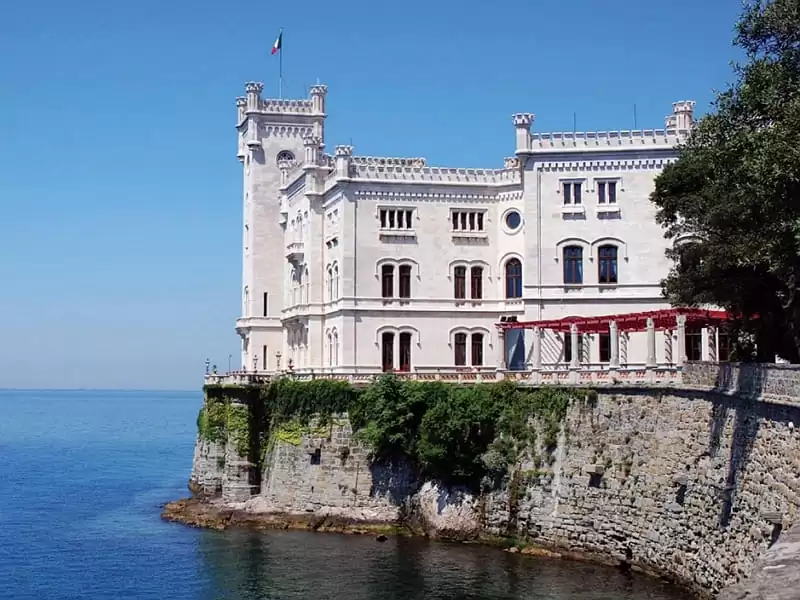
Apparently, after three days, Trieste’s inconspicuous aura began to release me, and I went to see the local “Swallow’s Nest” — Miramare Castle. Built in 1860 from light Istrian stone for Archduke Maximilian and his wife Charlotte, it witnessed a short idyll.
Maximilian went to Mexico on Napoleon’s adventurous offer and was shot there, and Charlotte went mad. Looking out of the castle windows at the blue Adriatic and the park, I couldn’t imagine anyone wanting to leave this place…
Practical Tips: How to Savor Trieste Without Rushing
When to Go
Spring and early autumn are ideal. In summer, it’s stuffy, and in winter, the bora wind blows both tourists and seagulls off the embankment.
How to Get There
- By train — 2 hours from Venice, 5 hours from Milan, 8 from Rome.
- By plane — Trieste Airport (Ronchi dei Legionari) is 33 km away, bus to the center ~50 min.
- From Slovenia — 1.5 hours by car or bus from Ljubljana.
Where to Walk
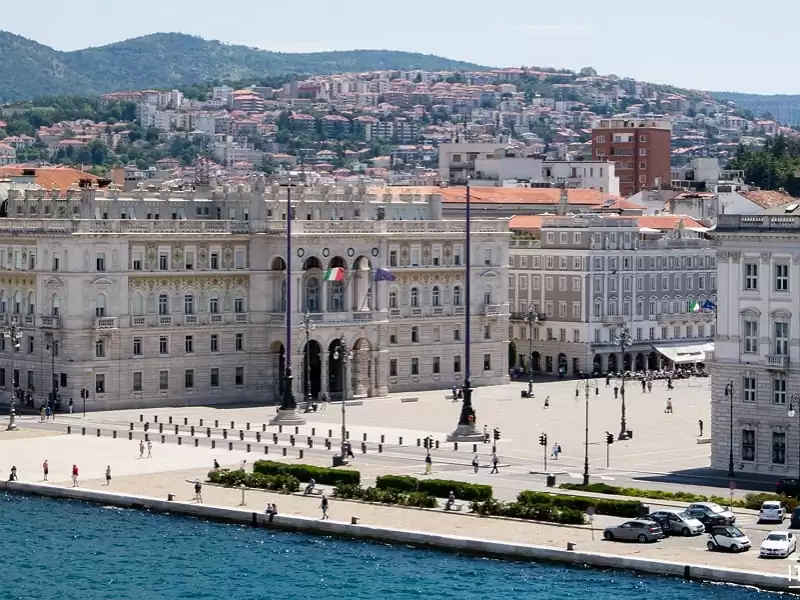
- Canale Grande and Piazza Unità d’Italia — the heart of the city.
- Borgo Teresiano district — clear Habsburg layout and shopping streets.
- Medieval Cittavecchia — narrow streets and a Roman amphitheater.
What to Try
- Frico — potato pancake with cheese.
- Slovenian “jota” — soup with sauerkraut, pork, and potatoes.
- Fritto misto — mixed fried seafood.
- Coffee at “San Marco” or “Tommaseo” — iconic city cafes.
Little Tricks
- Go up San Giusto hill by bus — saves strength and nerves.
- Come to Carso on weekends — that’s when the osmice are open.
- In the evening, it’s best to watch the sunset on Corso Cavour, with ice cream in hand.
“Trieste in 1 Day” Itinerary
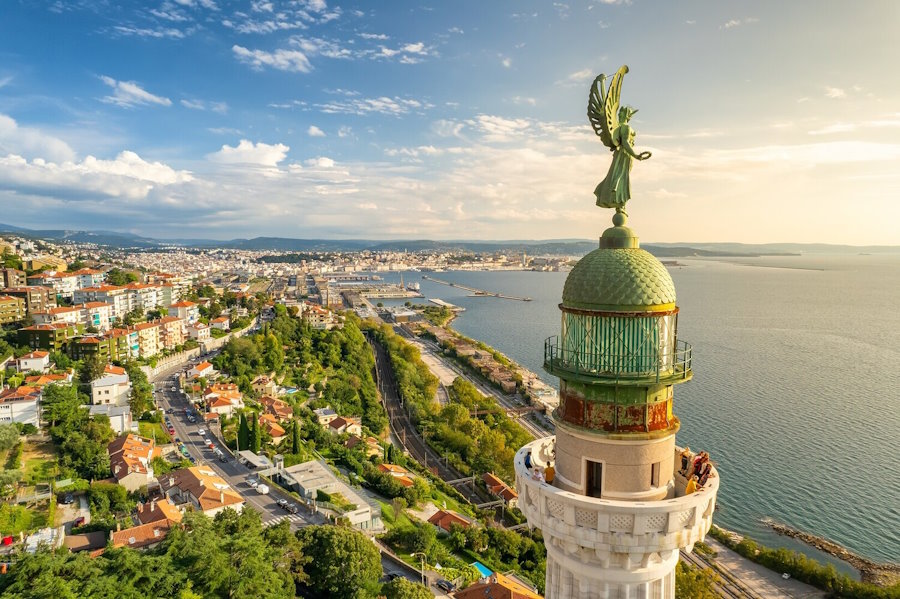
If you only have 24 hours, the city will still manage to charm you.
08:30 — Coffee at Caffè San Marco
Rich aroma, wooden panels, and the first pages of the morning newspaper.
At “San Marco,” coffee is served with such dignity, as if it’s not a drink but a ceremony. Wooden panels, bookshelves, old portraits — you can spend an hour here, watching people at neighboring tables. Sometimes it seems that time in this hall slows down a little.
A cafe that preserves a centuries-old atmosphere, and an old man who will tell you about Trieste without words.
10:00 — Walk along Canale Grande and exit to Piazza Unità d’Italia
Wide sky, marble tiles, and the sound of the sea below.
In Italy, Trieste seems to stand with its back to the country and its face to the sea. It looks towards Slovenia and Croatia, preserves traces of Austria-Hungary, but remains Italian to the core.
12:00 — Light lunch in Borgo Teresiano
Frico with a glass of local white wine.
Trieste: a city that whispers, not shouts. There’s no tourist noise of Venice or a flash mob in St. Mark’s Square. Here, by the sea, there is silence, coffee smells of time, and the bora wind turns over not only umbrellas but also thoughts.
14:00 — Climb San Giusto hill
Cathedral, castle, and panorama of red roofs.
San Giusto hill is the heart of the old city. Here are ancient Roman ruins, a medieval cathedral, and a castle whose walls preserve the history of many sieges. Walking up is a test, but a bus will take you almost to the top.
Where the wind freely roams among the stones, and from the height of the cathedral, all of Trieste is visible, as if in the palm of your hand.
17:00 — Wind and wine on the Carso plateau
A glass of Terrano with a sea view.
The Carso plateau is also an open-air museum. The “Path of Peace” route connects World War I fortifications, and preserved trenches on Mount San Michele bear inscriptions in Italian and Austro-Hungarian.
19:30 — Sunset on Corso Cavour
Aperol, laughter, and golden light over the waves.
Trieste sunsets are a spectacle where the sea and light play the main roles. In the evening, the embankment fills with locals, tourists, and seagulls, and in everyone’s hand — ice cream or a glass of Aperol.
On Corso Cavour, the sun sets slowly, as if the city doesn’t want to let the day go.
Echo of the City
Trieste is not a city that reveals itself instantly. It doesn’t scream about itself, doesn’t put on noisy shows, doesn’t bombard you with souvenir shops at every corner. It simply lives — between the sea and the stone, wind and sun, Italian warmth and Austrian restraint.
And if you allow yourself to linger here, even for a couple of days, you’ll understand: behind the Habsburg-style facades hide stories you’ll want to hear again and again. And the taste of coffee and sunsets will stay with you even at home — as a quiet reminder that there is a place in the world where you can simply breathe and gaze at the sea.