
Sitting on the terrace of a small hotel in the town of Takoradi, in western Ghana, I itch with the realization that I am one of those 1999 people whom mosquitoes forget about only when it’s time to procreate. Mosquito procreation, of course – those of us who have tried to procreate the human race on a stuffy tropical evening without a mosquito net know what a difficult task that is.
Meeting Johnson and Oscar
Next to me, my local manager, Chibuke Ogwibo Johnson, is swatting away insects with a twig and drinking beer. I can never figure out which part of his name is his given name and which is his surname, and I constantly vary my form of address. This large and very dark man doesn’t take offense. His favorite word is “cool.”
It’s a quiet evening, the sun has just set, so when a crackle and rustle passes through the treetops, Johnson and I turn our heads at the sound. A medium-sized monkey slides down a nearby tree to the ground and, comically dragging its bottom, heads towards our table. “Cool, that’s Oscar,” Johnson says, “they let him out for a walk again today.”

Oscar’s Story
After a couple of days in Takoradi, I already know about Oscar. He’s the pride of this small town, which, besides 4 gas stations, 3 banks, half a dozen cafes, and as many funeral homes, has its own menagerie. Oscar is actually from there. When the lock on his cage broke a few months ago, the zookeeper, following all proper procedures, sent a three-part request to the capital for money to buy a new one.
There was still no reply. Oscar learned to open his cage and cope with the zookeeper’s new improvisations for locking it. At night, he would go free and be an ordinary wild monkey, of which there were plenty around the town. After gathering the latest news from the wild, he would return to his cage by morning, because he was fed there, and he would uncomplainingly work his hours to the delight of visitors.
A trusting relationship developed between the zookeeper and Oscar, suiting both of them. Touched by the humane attitude of human civilization, Oscar loved people. He especially liked the changing rooms by the hotel pool, where Johnson and I were currently sitting. From there, he would snatch clothes and then disembowel them in the trees.
Guests would stand below, catching passports, credit cards, and money raining down on them. The hotel management was constantly complaining to the zoo administration, who just shrugged their hands, saying they were waiting for funds to buy a lock. The town’s population quietly rejoiced at Oscar’s Robin Hood-like initiative: the hotel guests were, for the most part, wealthy foreigners.
An Unexpected Protector
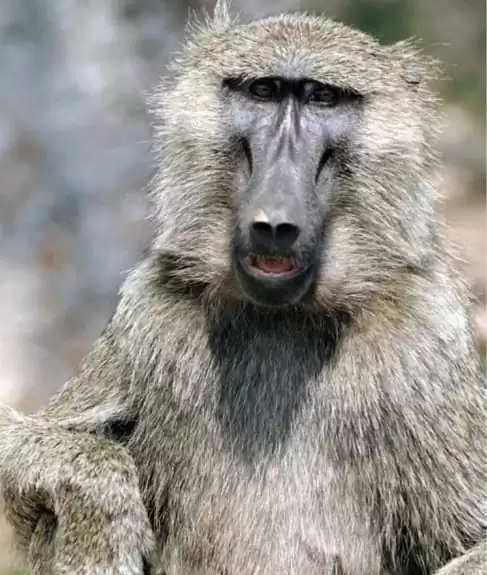
The waiter, who has been bringing us our second bottle of beer for about ten minutes, spots Oscar and resolutely approaches him with a stone in his hand. This is the standard approach of a simple Ghanaian to wild animals not yet fallen into the Red Book. Oscar jumps onto my lap, hugs me around the neck, and bares greenish and quite large fangs at the waiter.
While I’m recovering in my new role as a monkey’s protector, Johnson asks the waiter to hold off on the reprisal and, taking peanuts from a neighboring table, tries to entice Oscar with them. The waiter asks if he can put the peanuts on my tab. I nod, calculating when I last had a rabies shot and how many years it’s valid for.
Oscar snorts foully but doesn’t fall for the peanuts. Johnson’s attempts to forcibly detach the monkey from me elicit a growl and a menacing grimace. I console myself with the thought that Oscar is a domesticated monkey, so I start petting his head; he gratefully grunts and sighs, which makes me accept the situation. “Cool,” says Johnson, “I’ll go get the camera!” and we are left alone with Oscar for a minute.
The Star of Attention
Once out of danger, he starts rubbing his paw on my head, slightly scratching my skin with his claws. The duty manager comes over and asks if he can help me with anything. Usually, I always have something to ask a hotel manager in a third-world country, but now I’m at a loss. Then, at a respectful distance, the service staff and other guests gather and start gossiping.
Oscar doesn’t change position. Johnson takes a few photos. Then our driver, Julius, arrives and asks to be photographed with us. When strangers get close, Oscar presses himself closer to me. After Julius, two elderly German lesbians and a French couple, both of whom resemble the squirrel from the cartoon “Ice Age,” photograph themselves with us.

Going to the Movies
Before Oscar landed on my chest, Johnson and I were planning to go to the movies. In general, going to the movies in Africa is an experience in anthropological masochism. I know the film will be old, the copy bad, the sound unintelligible, and that it will reek of sweat. But the audience’s reaction is more interesting than what’s on screen; from it, I always learn something new about the city or country.
An Ethiopian cinema is different from a Tanzanian one, and both are unlike a Togolese one. And today it was Ghana’s turn, a recently built one, which, according to rumors, has air conditioning. Although I’ve had enough cinematic experiences today: I even received an Oscar! Life is full of absurd actions that seem perfectly logical at the moment they’re performed. “Shall we go with him?” Johnson asks jokingly. And why not, actually?
Oscar agrees to be held by one hand for a moment, and Johnson puts his big jacket on me and zips it up almost to the top. Only a shaggy tuft of the monkey remains visible. I don’t know about Oscar, but I immediately feel very warm. Julius drives us to the cinema. Of course, one could write that the film was “King Kong” or “Planet of the Apes,” but doesn’t going to the cinema with a monkey teach us that reality can be stronger than fiction? In the ticket line, people stare suspiciously at my snorting stomach.

Ticket Problems
The ticket-taker flares his already large black nostrils and calls the manager. Are we going to be kicked out now, considered a racial mockery for bringing a primate? No, the manager accuses us of trying to sneak in a fare-dodger and demands payment for Oscar. Johnson remarks that since Oscar doesn’t occupy a separate seat, the cinema is trying to profit from my difficult situation. Oscar stops snorting and pokes out his muzzle. Then I offer to buy him a children’s ticket. “Cool,” says Johnson. The manager agrees.
In the Cinema
The military man sitting in front of us takes off his boots and unbuttons his tunic to his navel. Then he begins to joke good-naturedly that my ancestors gave his ancestors the opportunity for a free cruise in the hold from Africa, to the plantations. Johnson tells him that I am “cool” because I’m from Russia, that black people were always carried on hands there, and that my ancestors invented internationalism. The film begins, but the taste of tension remains.
Halfway through the film, the powerful air conditioning is turned on, and within 10 minutes, the military man is buttoned up and wearing his boots again, while Oscar wakes up from the cold to the alarming surprise of a gaudily dressed lady in traditional Ghanaian attire, sitting one seat over. To her misfortune, she came to the cinema with a red plastic handbag. Oscar latches onto the bag, the lady doesn’t want to give it up, and, for some reason deciding that Oscar and I are acting in concert, showers me with reproaches.

Oscar starts to growl, and then Johnson buys him a mango from a vendor. The mango is as red and shiny as the handbag, and Oscar switches targets. But the fruit, apparently, is not part of his usual diet: he bites off pieces of the mango and spits them at the audience with enviable range. Polygamous Ghanaians, bored with an American comedy about divorce, immediately rush to buy mangoes themselves and spit them at Oscar, inevitably hitting me.
Leaving the Cinema
The ticket-takers call the manager, who is worried about the pristine condition of the new cinema hall and threatens forceful eviction. When Oscar reacts to the manager with screams and squeals, the audience completely forgets about the film and, in anticipation of a scandal, turns their backs to the screen. The lady reminds Oscar about her handbag and complains about me to the manager. I realize that I won’t be able to leave quietly.
The military man, who had just bought a mango, hurries to spit it at Oscar as we move towards the exit. Oscar is not used to such a zoo and starts to struggle to get away, and now I’m holding him with both hands. Johnson, at the last moment, treacherously stays behind to finish watching the film. Some “cool” he is! In the car, Julius thoughtfully changes the station from African rhythms to classical music, and the monkey calms down again.

Farewell to Oscar
When I step out at the hotel, Oscar slides off me smoothly, as if from a tree, and looks with his prickly eyes, as if pondering whether to hug me one more time for goodbye or if it’s enough. Deciding to forgo further emotions, he disappears into the bushes. I take a shower and lie down. But I can’t fall asleep. Suddenly, it feels strange to be alone.
It seems something developed between Oscar and me after our accidental but prolonged closeness. After all, who gets to experience such affection from a nearly wild monkey? It’s not some bloodsucking mosquito… Well, and I’m a little itchy, but not from mosquito bites. The monkey fleas, apparently, weren’t all washed off in the shower.