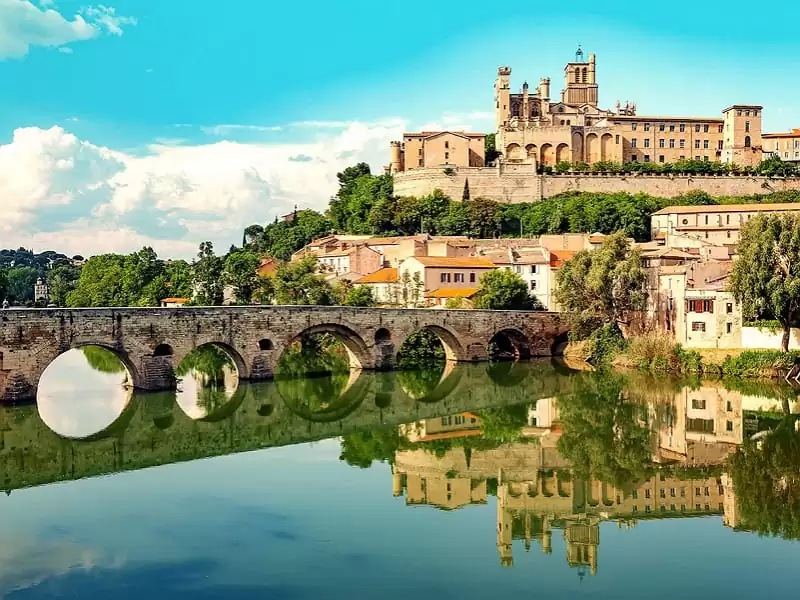
It’s an easily explained paradox: the more tourists are obsessed with finding their corner of “real” France, the harder it will be for them to do so. But there’s a land in southeastern France that, miraculously, has so far avoided the tourist spotlight, fortunately rich in beautiful cities, mountains, the sea, and the southern Gallic hospitality that you can no longer find in Paris. Its old name is Occitania. But look for Languedoc-Roussillon on the maps.
Saint-Marie Abbey in Lagrasse: A Century-Old History
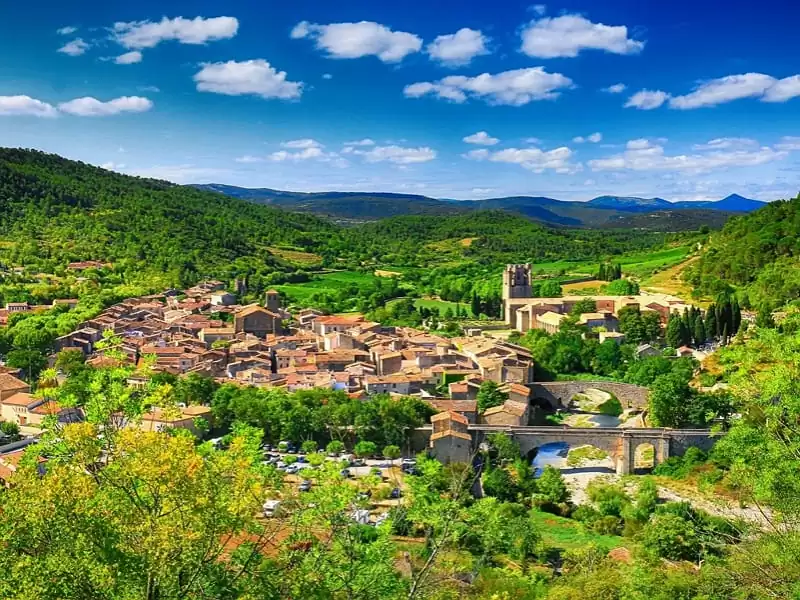
The bell tower of Saint-Marie Abbey has been admiring its reflection in the Orbieu River for over a thousand years. From its summit, you can see not only the inevitable plane trees along the roads radiating from the village of Lagrasse and the neat rolls of hay at the bend, but also the foothills of the Pyrenees, beyond which Spain begins. The possessions of the Lagrasse Benedictines once stretched all the way to Zaragoza.
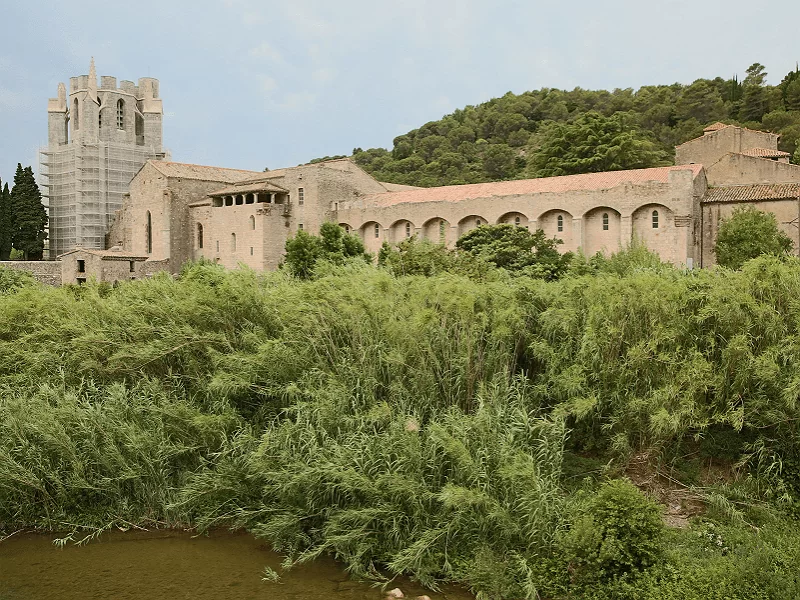
One of the oldest in France, the abbey was founded by Charlemagne in the 8th century. A talkative gray-haired lady at the entrance managed to whisper that the glorious emperor, by the way, fell off his horse in the surrounding mountains, and you can still pay homage to the imprint of the august backside on a rock. So I wandered under the ancient vaults of the monastic dormitory, ruminating on such a delicious piece of information, until I came across a mention of the Berlioz family.
The famous composer’s cousin bought half of the abbey in 1796 from the revolutionaries, who had expropriated it from the church. The revolutionaries asked for such a high price that buyers from the nobility, cautious about showing their wealth during the Thermidorian Reaction, couldn’t be found. So they sold the abbey to different hands, and now you have to buy two tickets to see all its charming nooks and crannies.
Wine Routes and Cathar Castles
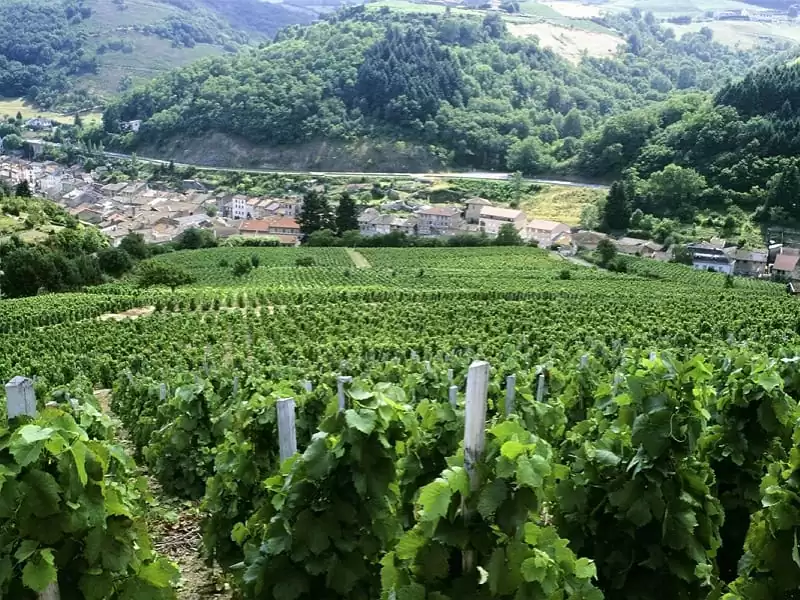
Actually, this tiny Lagrasse wasn’t even in the plans. The plans included France’s second most visited city – Carcassonne. But if you’re driving through the French countryside and not on the main roads, be prepared for your plans to change constantly. Especially if the route lies among the vineyards of the Corbieres appellation, and every few kilometers invite you for a tasting.
It’s not the same as stopping by the side of the road to buy fruits and vegetables: you stop, take a sip, spit, and drive on. In May, June, July, the grapes fill themselves with juice under the sun, the winemakers are relaxed and predisposed to conversations, so a stop at just one estate can break a carefully planned itinerary by expanding winemaking knowledge about the characteristics of local terroirs and concepts about the foundations of French civilization in general.
One winemaker explained it to me this way: “What is wine? It’s 80% culture and 20% alcohol.” Or rather, Catalan-French civilization, those knowledgeable in history will correct me, because these lands only passed to France in 1659 under the Treaty of the Pyrenees, and until then were part of the Kingdom of Aragon and Majorca. Times were turbulent, on the tops of the hills, here and there, you can see castles of varying degrees of preservation, in which mortes payes (peasants exempt from taxes for defending the castle) defended their owners from raids.
Many citadels have existed since Roman times, such as Peyrepertuse and Quéribus. Both played a role in the fight against the Cathar heresy, to eradicate which Pope Innocent III sent one crusade after another in the early thirteenth century. The crusaders captured cities and mowed down the local population indiscriminately; it was then that the famous phrase arose: “Kill them all, God will recognize his own.”
Carcassonne: A Fairytale Image and Reality
Quéribus was the last stronghold of the Cathars, it fell in 1255. However, the Cathar faith proved strong: the last adherents were burned at the stake only in 1321. The most famous castle in France, of course, is Carcassonne. When half a dozen of its 52 turrets under cones of blue roofs suddenly pop out over the vineyards, it seems that it arose from a fairy tale. And so it is: Disney based the castle in “Cinderella” on it.
This is the secret of its popularity: the archetype of the romantic castle, embedded in the minds of most visitors since childhood, becomes a reality. And what else is needed for happiness?! In the case of Carcassonne, the imagination doesn’t even need to restore anything – Viollet-le-Duc did it for it! It was he who, in the mid-19th century, rebuilt the castle, which had been condemned to destruction and which the surrounding peasants were systematically dismantling for stones in a mass act.
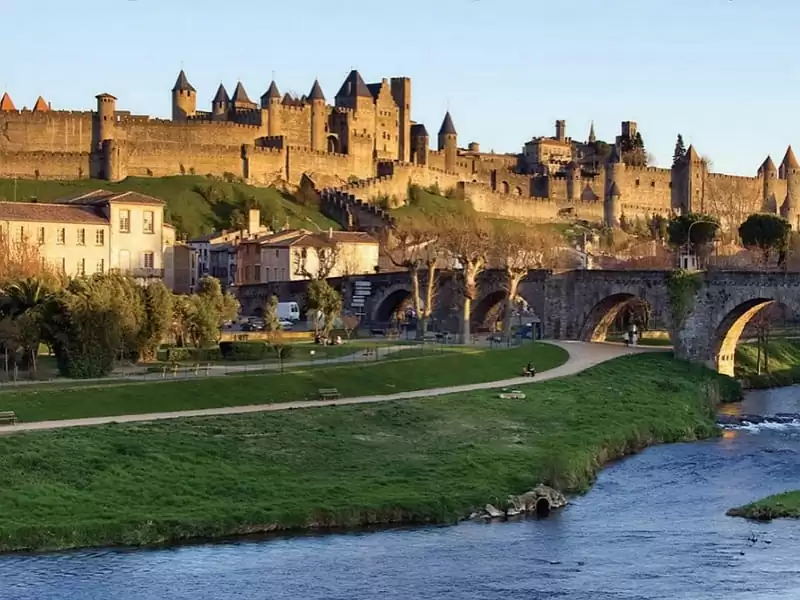
I’ll be the first to throw a stone taken from behind my bosom at the fortress wall of Carcassonne for its idealized sentimentality, for the fact that the product of restoration turned out to be more photogenic and “medieval” than the original. The unpardonable faux pas is the fortified bell tower of the basilica. But if Le Duc created a cliché castle, it would be unfair to hold him responsible for the medieval Disneyland arranged inside the fortress.
Through the Ages: Legends of Carcassonne
None of the 120 people living there today practice crafts, but there is no shortage of shops selling pocket crossbows, models of the castle made of nougat, and children’s plastic armor, which are briskly sold near the torture chamber. Carcassonne is Mont Saint-Michel, from which the sea has retreated very far. Crowds of tourists seem glad that they took the city without blood, and now mindlessly and absurdly part with their euros, celebrating an easy victory.
But as soon as I stepped outside the gates and fell into the waist-high grass under the fortress walls, I immediately found myself alone. The two-thousand-year history of Carcassonne can be read on its walls. You don’t have to be an archaeologist to notice that the stones of the 3rd century in the inner walls are smaller and coarser than the stones of the 13th century in the outer walls, and to understand when approximately the holes in the walls were repaired. The towers on the outer wall were built further apart from each other, because by that time crossbows had appeared, and they were more accurate than bows.
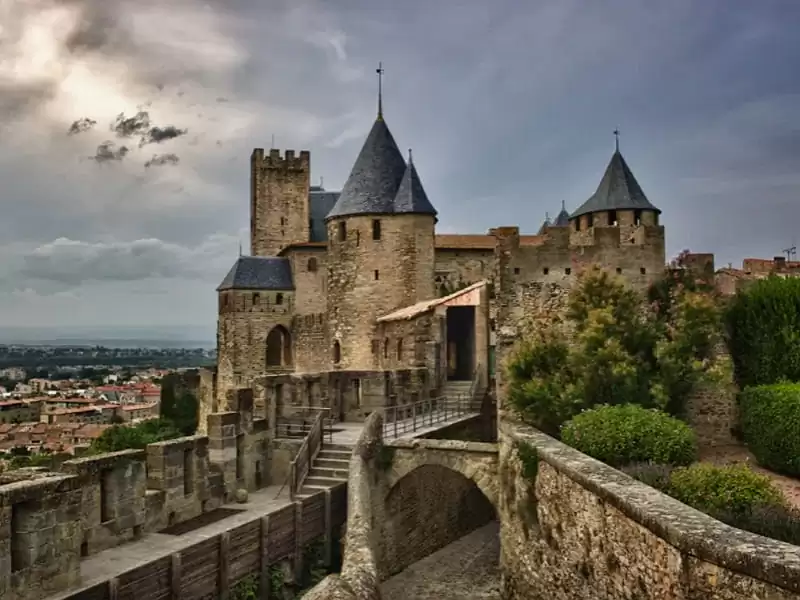
It was best to walk along the walls in the evening, when they emerged from the darkness in the light of yellow spotlights, and only my shadow slid along them – by this time, tourist groups had successfully finished their cassoulet in the lower city on the other side of the Aude River. Only at the drawbridge of the Narbonne tower, which used to always have a thousand salted piglets stored in case of siege, two subjects of indefinite occupation were drinking canned beer and, judging by the loud dialogue, were in dire need of a snack.
Their bench feast was taking place under the benevolent gaze of the stone widow Carcas. When Pepin the Short besieged the fortress in the 8th century, and her husband died in the siege, she figured out how to deceive the besiegers, and then she herself rang the bells when the siege was lifted. That’s why, they say, it’s Carcassonne – Carcas sonne. A legend, of course, but beautiful…
Canal du Midi: A Water Artery and the Soul of the South
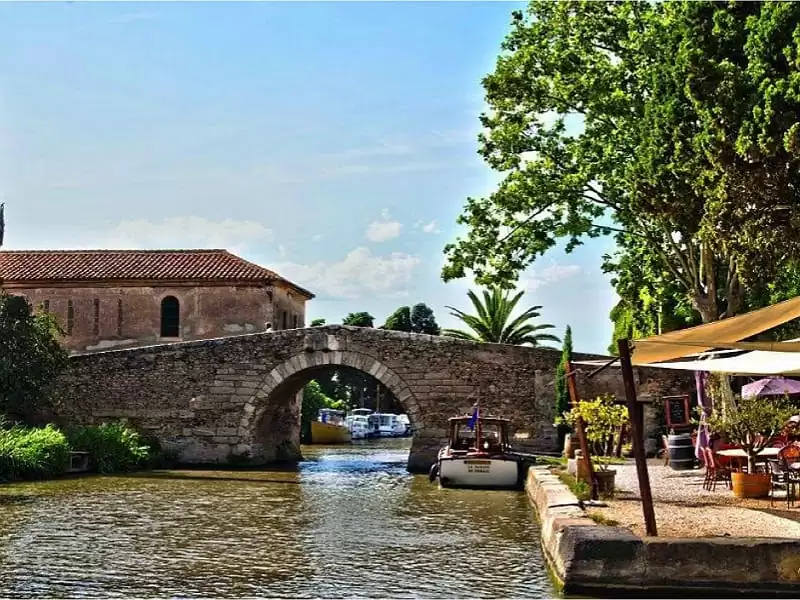
It’s spectacular to say goodbye to Carcassonne from the deck of a pleasure boat departing along the Canal du Midi to the east, towards Toulouse, or to the west, towards Béziers. In partnership with the Garonne, the canal connects the Atlantic with the Mediterranean, as its inspirer Pierre Paul Riquet dreamed, who convinced Louis XIV of the expediency of an alternative to a month-long navigation around hostile Spain and invested all his fortune in the implementation of the idea.
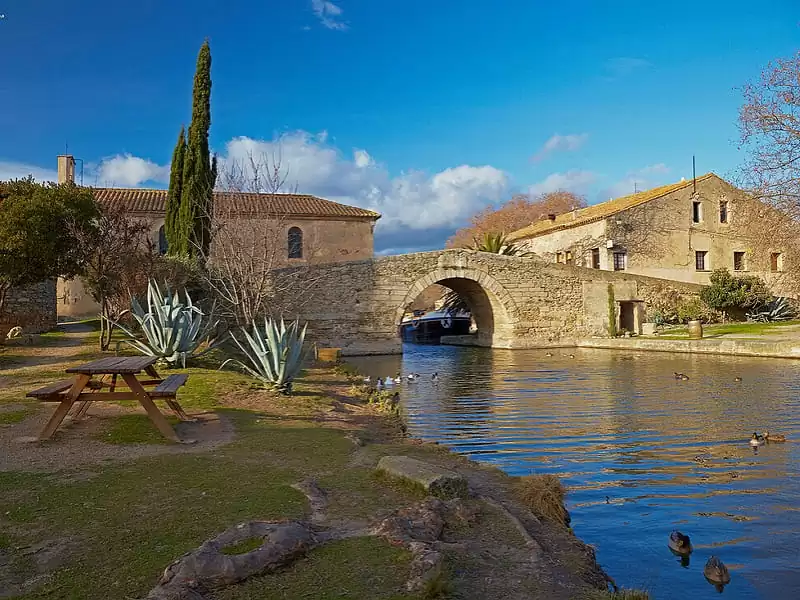
The construction of the canal took 15 years, for its time it was a very ambitious project: three aqueducts over rivers and one 170-meter tunnel. Riquet died a few months before the opening and did not see either the barges with grain that filled the canal, or the prosperity that it brought to this part of southern France. Today, the aqueducts and oval locks of the canal look the same as they did under Riquet, but against their background the masts of yachts stick out, seeking a calmer way to get from the sea to the ocean or vice versa.
There are also many one-day pleasure boats, whose passengers were fond of the status of a monument of cultural heritage of humanity, issued to the canal by UNESCO in 1996 (Carcassonne also received one). There is no cargo navigation along the monument now, and passenger navigation is extremely slow: we spent an hour in the lock – until the lock keeper finished his petit dejeuner (breakfast), no one was rushing him.
Guardians of the Canal: Encounters with Authentic France
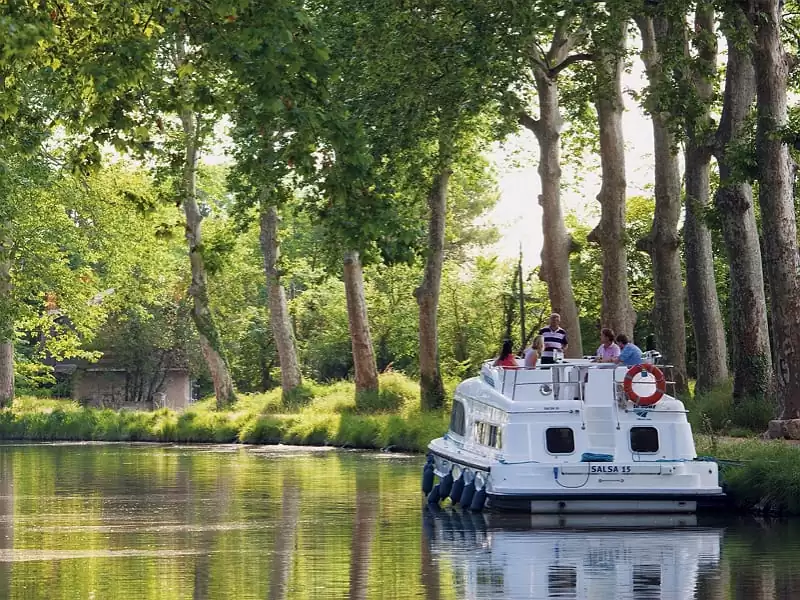
Under the rumble of the engine, our peniche – a boat similar to a barge with a raised bow and stern – glided from one impressionistic canvas to another. When, as if after my silent applause to the landscapes, plane trees came out in a row along the canal, walking along the eroded bank with calloused roots, the exhibition of impressionists was interrupted. “40 thousand plane trees were planted for shade along 240 km,” the pilot-captain muttered more for form’s sake, because there was nothing to say here.
The people, it seemed, were distracted from the beauties when we passed through the locks, but they too were a picture: seeping into the cracks of the old gates, the water staged a fountain performance, always different, but always riotous. I was all looking for my colorful elderly lock keeper, who would make a worthy company for the ideal Carcassonne, but instead I came across young guys who got summer jobs and switched to English when they heard my mangled articles.
Before one lock, two quite imposing pensioners were spotted on a bench under the willows. But it quickly became clear that their main occupation was to laugh at the awkwardness of tourists who had rented boats and were inexperienced in the art of lock operation. The spectacle was indeed not boring: the Italians good-naturedly bickered, the French were on the verge of a breakdown, the Danes were nervous in silence, and the English looked at everyone with the arrogance of seasoned sailors.
And then he came out of the house: mustachioed, with a twinkle in his eye and gray temples under a straw hat. Undoubtedly, Antoine (that was the lock keeper’s name) was a real veteran who had dedicated most of his life to the canal. “6 years,” he corrected me, “since I moved here from the big city, and I’m extremely happy about it.”
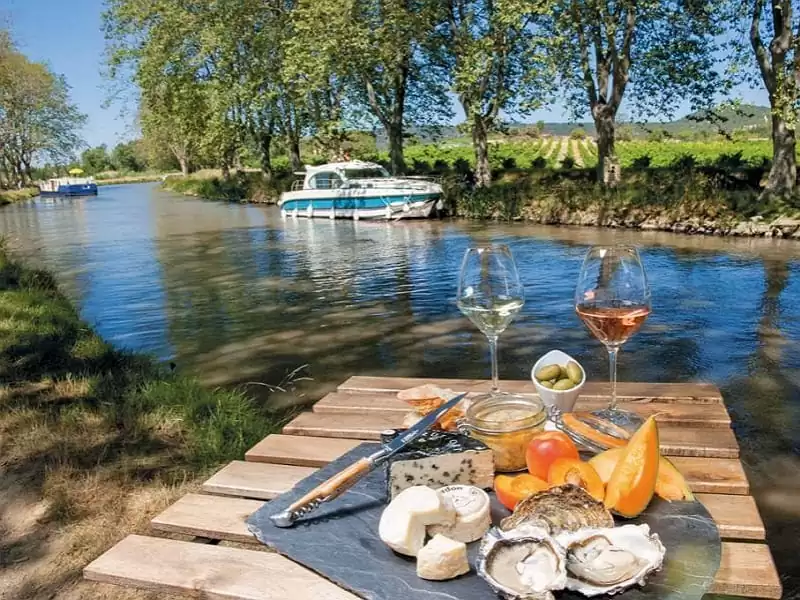
A Corner of Real France
Antoine was missing a tooth, but his smile belonged to a man satisfied with his place in life. His surroundings confirmed this: a patch of land around the lock was lovingly turned into a garden with roses, petunias and hibiscus bushes, which Madame trimmed. His piece of France could not fail to attract attention, and soon all the members of the international flotilla, which had accumulated in his lock, were already expressing their admiration to him.
Antoine didn’t care about either the high-speed TGV train, which could take him from nearby Toulouse to Paris in 6 hours, or the largest Airbus in the world, which was being built in the same Toulouse at that moment. He opened and closed the gates of the lock, tended his garden and exchanged jokes with those passing by with the look of a man for whom this was the very essence of life. It’s an easily explained paradox: one’s corner of real France is much easier to find… with the French.