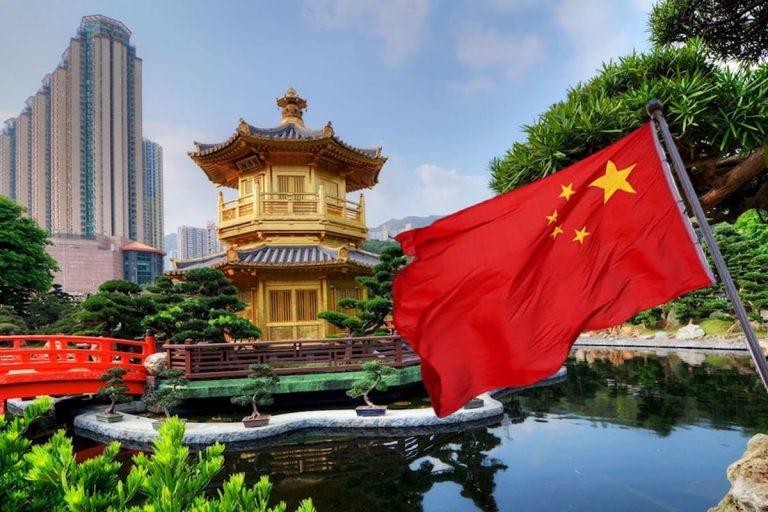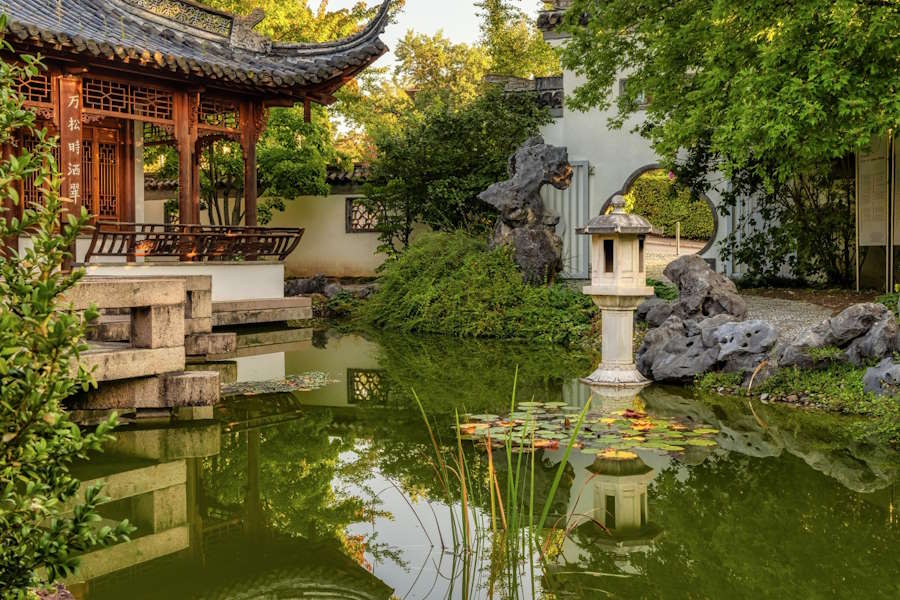
In a Chinese garden, you don’t just stroll—you converse with the world. Stones answer with a muffled echo, water winks with glints, willow branches rustle like the pages of an ancient book. Here, nothing exists “on its own”; everything is in dialogue. Emptiness is also a word, and silence is a sound that needs no amplification. Such a garden is neither a model of nature nor an open-air museum. It is a condensed universe, where every step, every bend in the path is like an edit in a delicate film about how to live with the world and with yourself.
Origins: the garden as a path, not a place
The Chinese tradition of gardens was born at a crossroads of ideas. Daoists teach us to hear the “Way”—not a straight line, but the shimmer between forms. Confucians teach measure and refinement. Buddhists teach us to see emptiness as form and form as emptiness. All this gathers into a special spatial logic without a “main facade”: an entrance might be placed at an angle where you see nothing but a wall with a warm shadow of bamboo—so you can attune yourself and shed your haste.
- In the Han and Tang eras, imperial gardens already combined water, stones, and pavilions into compositions like poems.
- Under the Ming and Qing, the language grows more intricate: calculated routes appear, “window-frames” as shots, multi-step perspectives, and a deep work with sound and light. The garden becomes a camera obscura where reality is set to a long exposure.
The garden does not depict nature—it “compresses” mountains, rivers, mist, and wind to the scale of a single walk. You proceed—and experience seasons, heights and valleys, fates and pauses within a few hundred steps.
Garden grammar: water, stone, emptiness
- Water is breath. Its surface now whitened by wind, now smoothly reflecting a pavilion roof, turns it into an inverted world. In spring ponds swell, in summer they thicken with willow shade, in autumn the fire of maples falls upon the water, and in winter the water blackens and becomes almost inky—for the calligraphy of birds.
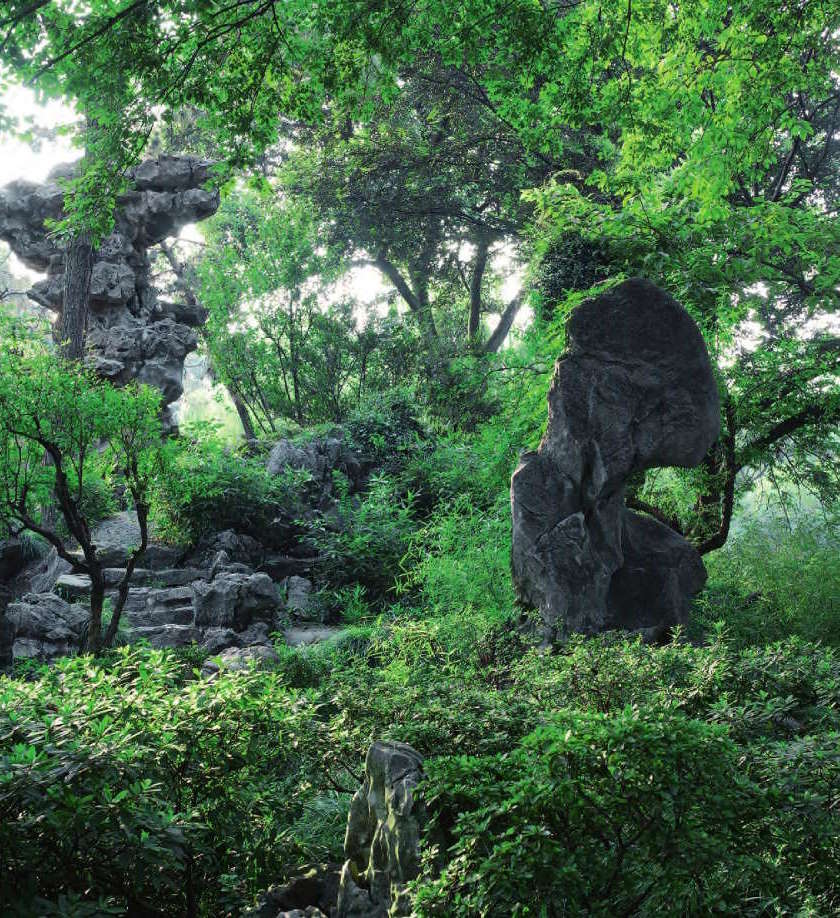
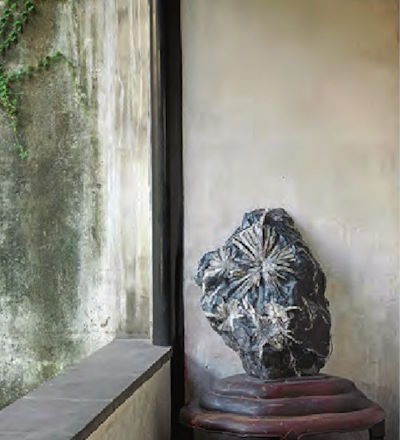
- Stone is the skeleton. Porous Taihu boulders seem carved by sea and time, with “cave” holes and apertures through which the eye passes like a traveler over a pass. Stone groupings are arranged like choruses: there is a soloist—distinctive, “scarred”; a second voice—softer; and a background without which the salt would not be so bright.
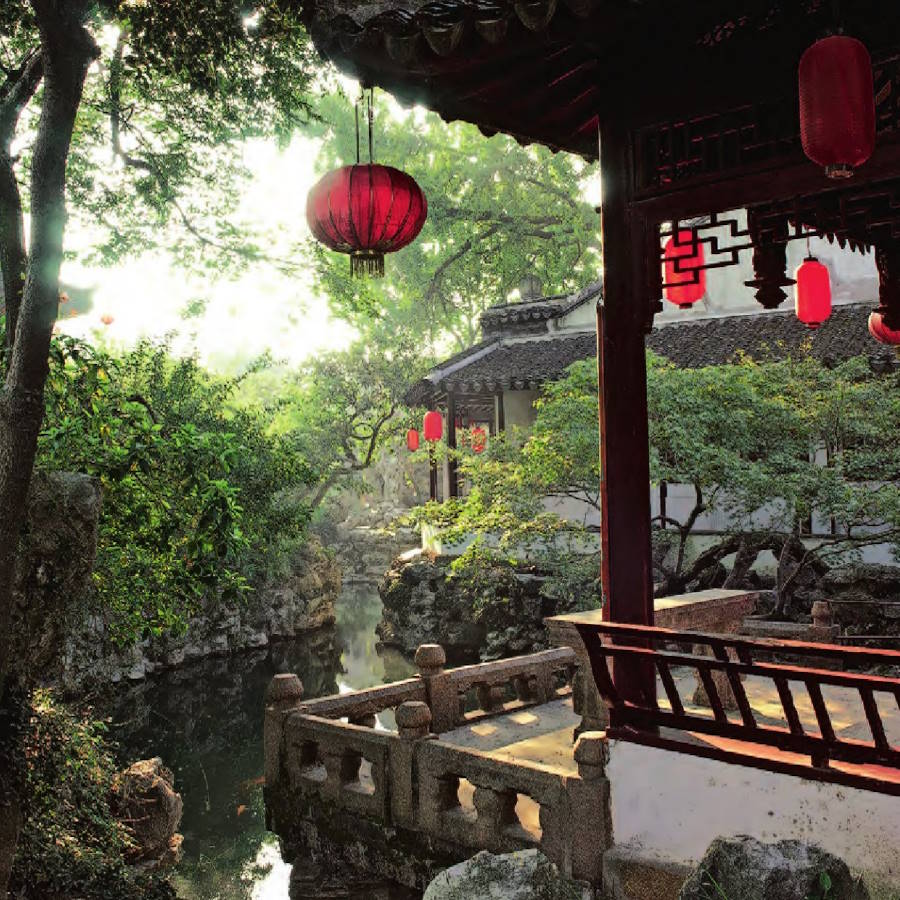
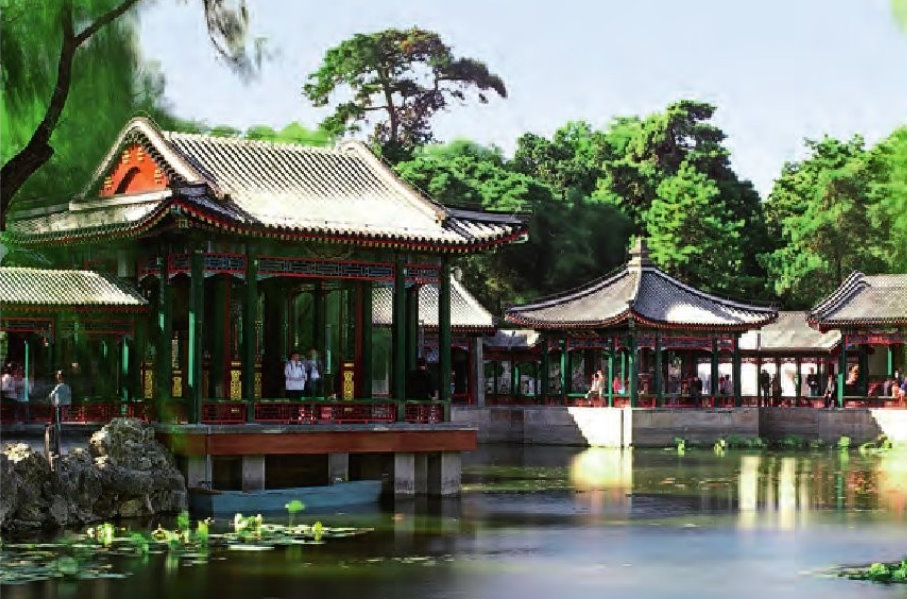
- Pavilions are points of breath. You step out of the gallery’s shade—and at the pavilion’s corner you’re not given a “view” but a meeting: a slice of water in the window, a stone “sagan” on the table, and all around the scent of dried wood and lacquer. Here, you don’t look at “panoramas”; you listen to how the gaze rhymes near and far.
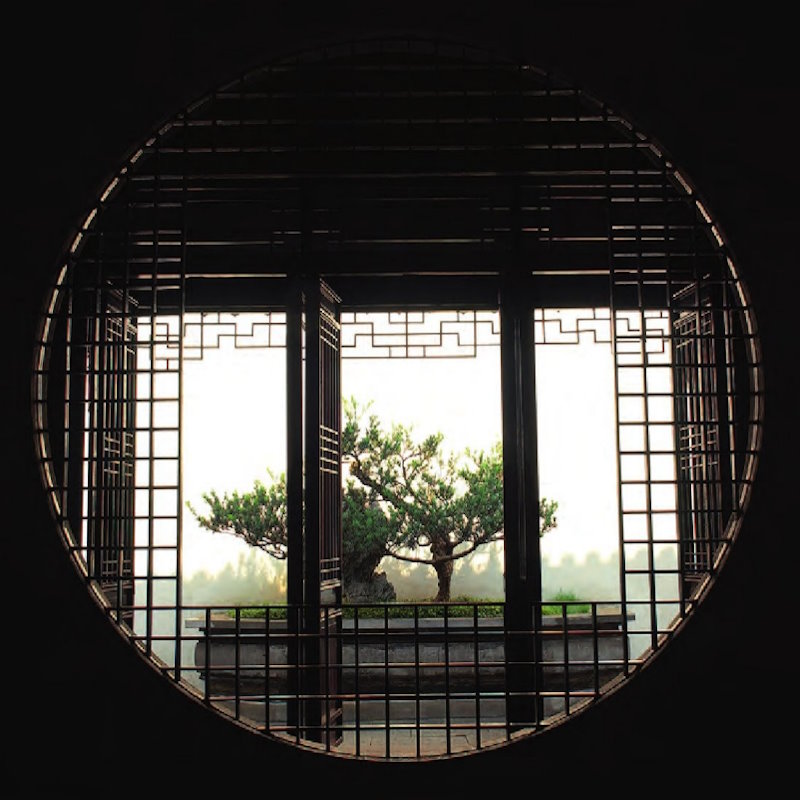
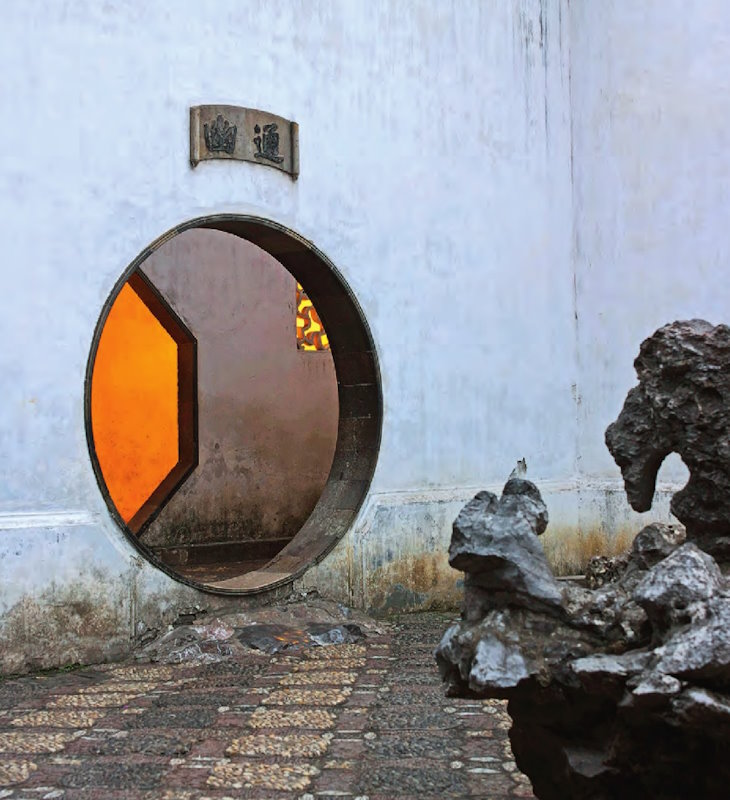
- Emptiness is a phrase without words. Moon gates, carved windows, blind walls with a turn—these are the pauses by which space speaks not louder but more expressively.
The garden is not about “seeing everything at once,” but about “seeing in sequence.” The direction is in your step: two more—and the reflection in the water breaks into scales; three more—and the holed stone suddenly resembles a dragon; five more—and the shadow of bamboo on plaster turns into an ink wash painting.
Imperial landscapes: power as the art of silence
In Beijing, the ensembles of Beihai and the Summer Palace are not merely “parks,” but intonations of the empire. Here water is a “sea,” the island is the “abode of immortals,” the white pagoda is a nail in the sky that fixes the clouds so they don’t carry away the meaning. The Long Corridor of the Summer Palace, painted with stories and birds, is like an endless line of text you can read in any direction. And somewhere by the shore a tree leans just enough to reflect in the water as a question mark precisely as the architect intended.
Yuanmingyuan—the Gardens of Perfect Brightness—is one of the bitterest stories. It was conceived as an encyclopedia of beauty where Chinese classics met European pavilions and fountains. Its destruction in the 19th century became a trauma of memory that still sounds in the silence of the ruins. Yet even the ruins here are not an ending, but a comma: grass, water, and stone continue to speak.
Suzhou and the chamber poetics of private gardens
In Suzhou, the world becomes miniature and intimate. The Humble Administrator’s Garden guides you imperceptibly, as if the host were whispering: “First this way, then over there—but don’t hurry.” The stone “lions” in the Lion Grove Garden are like awakened boulders that have gathered to confer about something. The Garden of the Master of the Nets is a lacework of paths and niches where water hides and reappears like a thought that just slipped away and—there—returned with a different light.
In a small area, an entire geography fits—a valley, a pass, a “lake within a lake” thanks to a “broken” bridge line. The composition is cinematic: now you walk in light, now in the weightless shade of bamboo, now you pause at a window where a piece of sky is cut in the shape of an octagon.
How to read the garden’s language
- Don’t seek symmetry—balance replaces it, as in music: the melody flows, but the key holds.
- Walk in a zigzag and slowly. The garden is built like a haiku cycle: step, gaze, pause—and again.
- Listen to sounds. Water, footsteps on stone, wind in bamboo—this is not background; it is a score.
- Look through. Framed windows and doorways are editing cuts. They make space multi-layered, like fine fabric.
Time and scars: destruction as part of memory
Many gardens have survived fires, wars, dismantling for stone, and long periods of neglect. Chinese landscapes have a remarkable capacity for retrospective breathing: stones can be gathered anew, water can be set along former paths, trees can be planted so they take their “voices” in the chorus. But the mark of time is not erased—it makes the text deeper. The patina on the paving slabs is already the calligraphy of epochs.
Why it works to the point of goosebumps:
- Because a garden is an editing of meanings: near and far, dense and empty, fluid and solid.
- Because ancient knowledge of comfort is applied here: shade in summer, wind protection in winter, water as the air conditioner of space, stone as a reservoir of coolness.
- Because the person here is not a spectator but a co-author: with their movement and gaze they complete the text begun by the masters.
In China, stones are often brought indoors and even set on pedestals like sculptures. Sometimes they are decorated with carving and painting.
Today: living heritage and new dialogues
- Protection and status. The Classical Gardens of Suzhou, the Summer Palace, the Forbidden City—are on UNESCO lists. This means scholarly restoration, monitoring of humidity, and the condition of stone, wood, and lacquered surfaces.
- Restoration precision. Stones akin to historical Taihu are quarried; water systems are recreated not by simply “pouring water,” but by restoring correct levels and flows; roof angles and the rhythm of eaves are observed.
- Tourism and delicacy. Millions of visitors are a trial. Timed tickets are introduced, “quiet corridors,” and pavements of traditional slabs so that footsteps sound as they should and don’t destroy the fabric of the paths.
- City and ecology. The principles of old gardens are sharply contemporary again: blue-green infrastructure, stormwater retention, cool corridors for heat. Beijing, Suzhou, and other cities are learning from the classics.
- The authenticity debate. Yuanmingyuan is a debate over what to restore literally and what to preserve as ruins so that memory can breathe. Conservation of ruins coexists with delicate restoration of water routes and pavilion “signs.”
- Digital optics. 3D scanning records cracks in stones, subsidence of embankments, fading of paintings. This is a quiet science that helps preserve poetry.
Fun facts: little secrets of a great art
The “broken bridge” is no whim. Zigzag bridges are not just picturesque: according to belief, evil spirits walk only in straight lines. And a turn changes the angle—each step gives a new “frame.”
- “Moon” gates are a lens. The rounded shape softens light like an aperture and cuts an “ideal circle” from the world. Photographers knew this long before cameras—on foot.
- Stones as a collection. Expensive porous Taihu rocks could cost as much as a house. They were chosen “by character”: a good stone has a “face,” a “back,” “caves,” and “passes.” Some had names like people.
- Water as an air conditioner. Ponds and canals cool the air and moisten the wood. The roof angle and eave length are calculated so that rain has a sound—part of the garden’s acoustics.
- A gallery as a raincoat. Long galleries are not only beautiful: you can walk along them in rain and scorching sun. The gallery’s line is a melody that leads you “without getting wet.”
- Plants are not a “flowerbed.” Every tree has a role: pine—steadfastness; plum—rebirth; bamboo—integrity. And bloom times are arranged so the garden “sounds” year-round.
- Reflection as an instrument. A pavilion may be deliberately “overloaded” with pattern—but in water it becomes perfect, like a stroke of ink. Reflection is a second chance at harmony.
- Mini-geography. An island in a pond often symbolizes the legendary Mount Penglai—the abode of immortals. Crossing the bridge, you “cross the sea.”
- Architecture “with pauses.” Blind walls are not thrift but direction. They let the eye rest so the next view “enters” more strongly.
- A touch of Europe. Yuanmingyuan had European pavilions and fountains by Jesuit architects. East and West conversed there quite respectfully—until whispers were drowned out by cannon fire.
A route of inner contemplation
In a Chinese garden you learn to walk softer and look slower. You understand that a pause is not emptiness but a stage for meaning. That a stone can be more certain than a word. That you cannot hold water—but you can offer it a channel. And gradually you notice how this garden is transplanted within: into a way of listening to people, choosing the day’s tempo, arranging furniture in a room so there is space for silence.
A Chinese garden is the art of assembling the world from hints. A rare case where the walk is quieter than words, and memory louder than photographs. And the slower you go, the more it speaks.