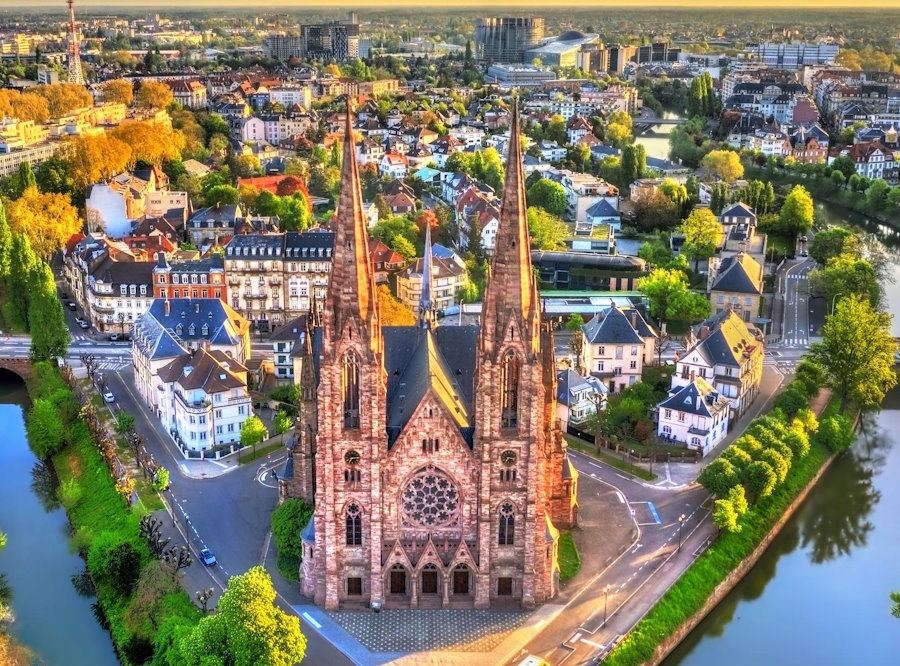
Hello travelers! Today we’re teleporting to the heart of Europe, to a region where languages, tastes, and architectural styles mix. We’re talking about Strasbourg – a city that for centuries couldn’t decide whether it was French or German, and eventually became the capital of Christmas and European bureaucracy. But there is one dominant feature that can be seen for kilometers, even when approaching the city by plane (if you’re lucky with the weather, of course). It’s Notre-Dame de Strasbourg, or Strasbourg Cathedral.
Forget boring guidebooks with dry dates. Let’s figure out why this “pink angel” is worth traveling half of Europe for just one glimpse of it.
Stone That Changes Color: The Magic of Vosges Sandstone
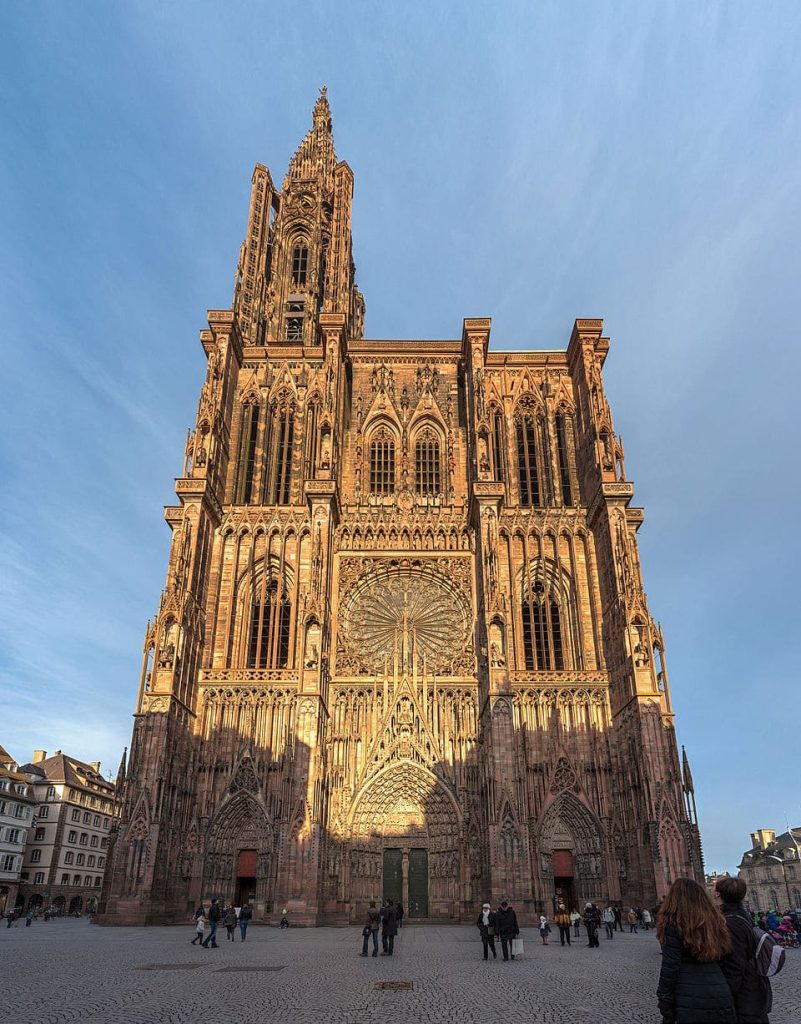
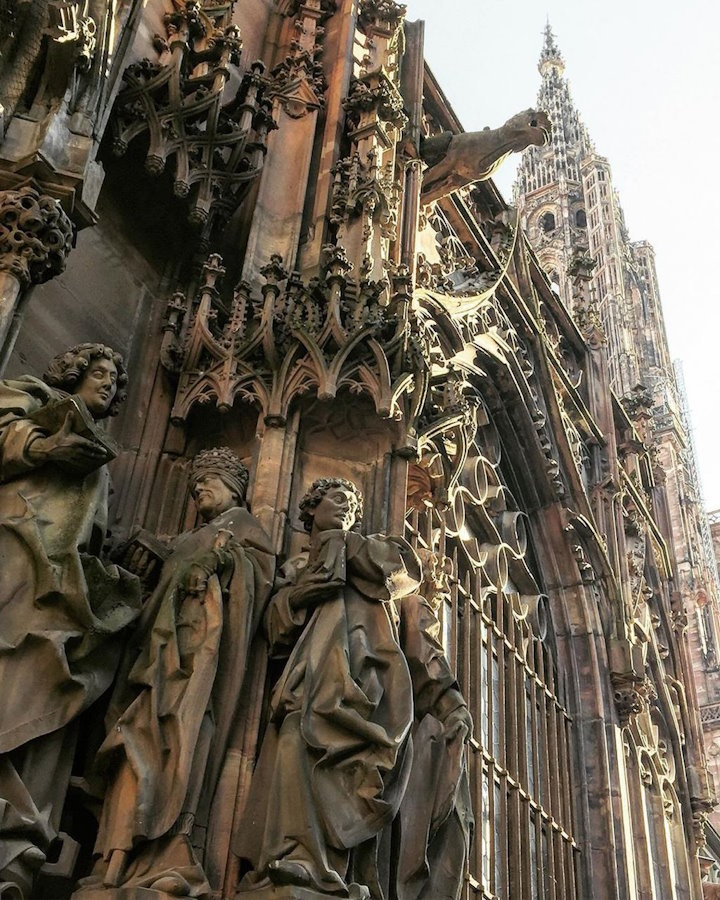
The first thing that catches your eye when you enter the cathedral square is the color. We are used to the snow-white cathedrals of Italy or the gray Gothic behemoths of Britain. But Strasbourg Cathedral is a completely different story. It is built of pink Vosges sandstone.
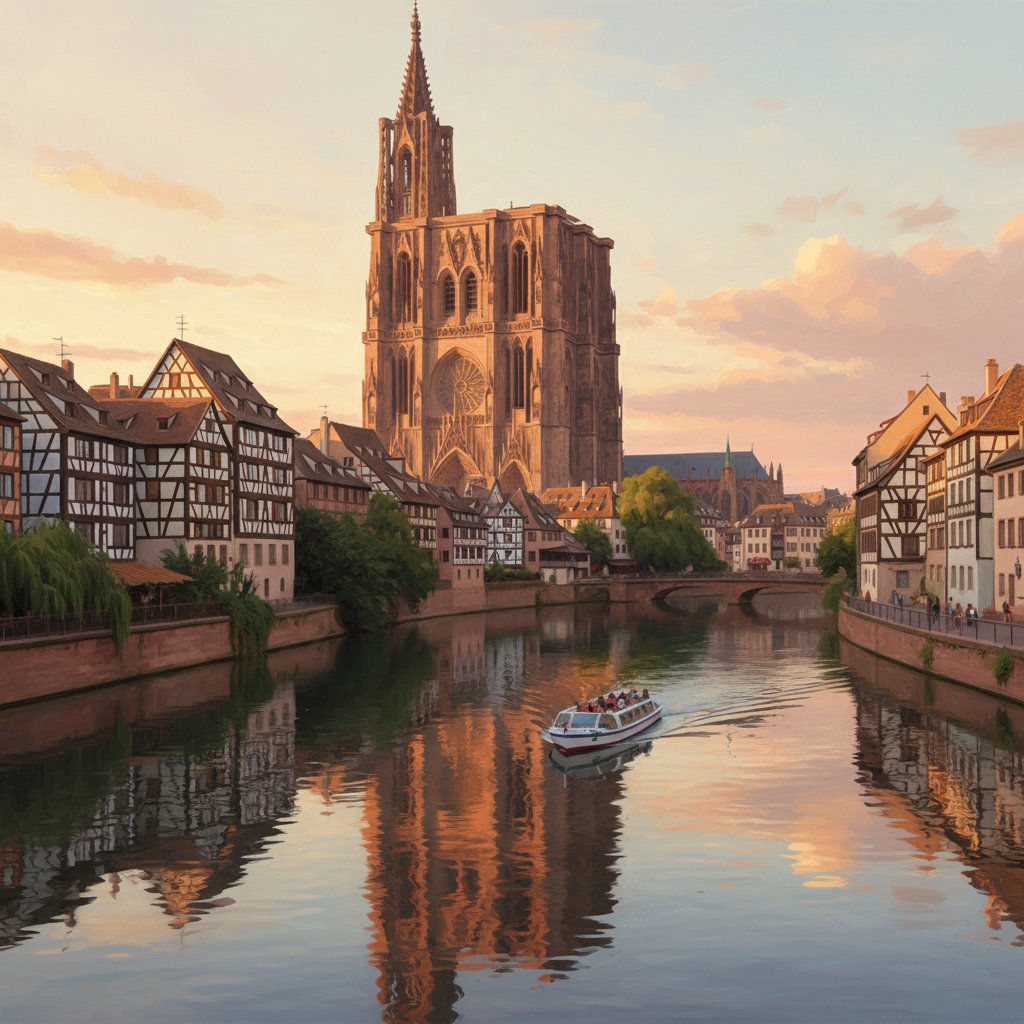
And this is not just a building material, it is a real chameleon. In the morning, when the city is just waking up and smells of fresh croissants, the cathedral seems delicately peach-colored. During the day, under the bright sun, it becomes almost ochre, warm, and cozy. But at sunset, the real magic begins: the walls flare up fiery red, like molten iron. Photographers from all over the world, from Japan to Canada, spend hours guarding this “golden hour” to capture the very moment when the cathedral burns without fire.
By the way, sandstone is a rather capricious and soft stone. Because of this, restoration never stops here. It’s like renovating an apartment – you’ve just started, and you already need to fix something new. So, if you see scaffolding – don’t be upset, it’s a sign that the old man is being taken care of.
A Lonely Tower and Dreams of Symmetry
Have you noticed that it only has one tower? Yes, it looks like the architect just waved his hand and said: “Oh, that’ll do, the budget ran out.” In fact, the story is much more interesting.
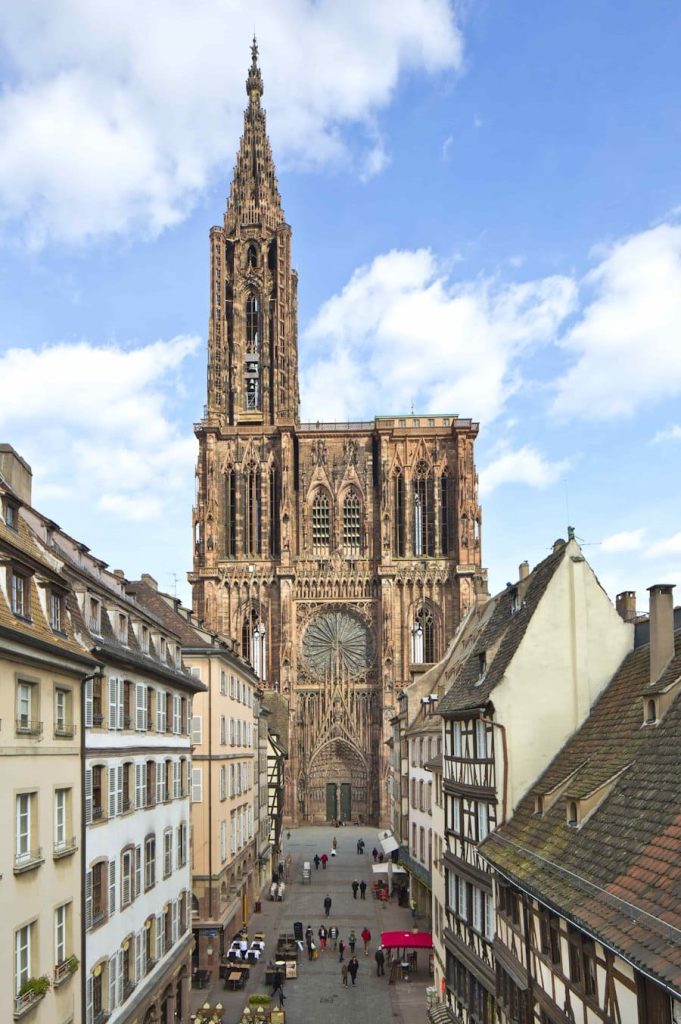
Originally, two towers were planned, like at Notre-Dame in Paris. But the construction dragged on for centuries (literally, from 1015 to 1439), styles changed, and money appeared and disappeared. As a result, the North Tower was completed to a dizzying height of 142 meters, making the cathedral the tallest building in the Christian world for 400 years! But there was simply not enough strength or money for the South Tower.
Locals, by the way, joke that a second tower is not needed because it would block the sun. And there is some truth in this – the cathedral is so huge that in the narrow streets of old Strasbourg you feel like an ant next to an elephant. Today, this asymmetry is the main feature of the cathedral. It makes it unique, imperfect, and therefore somehow very alive and human.
A Clock That Knows Everything (Even When Easter Is)
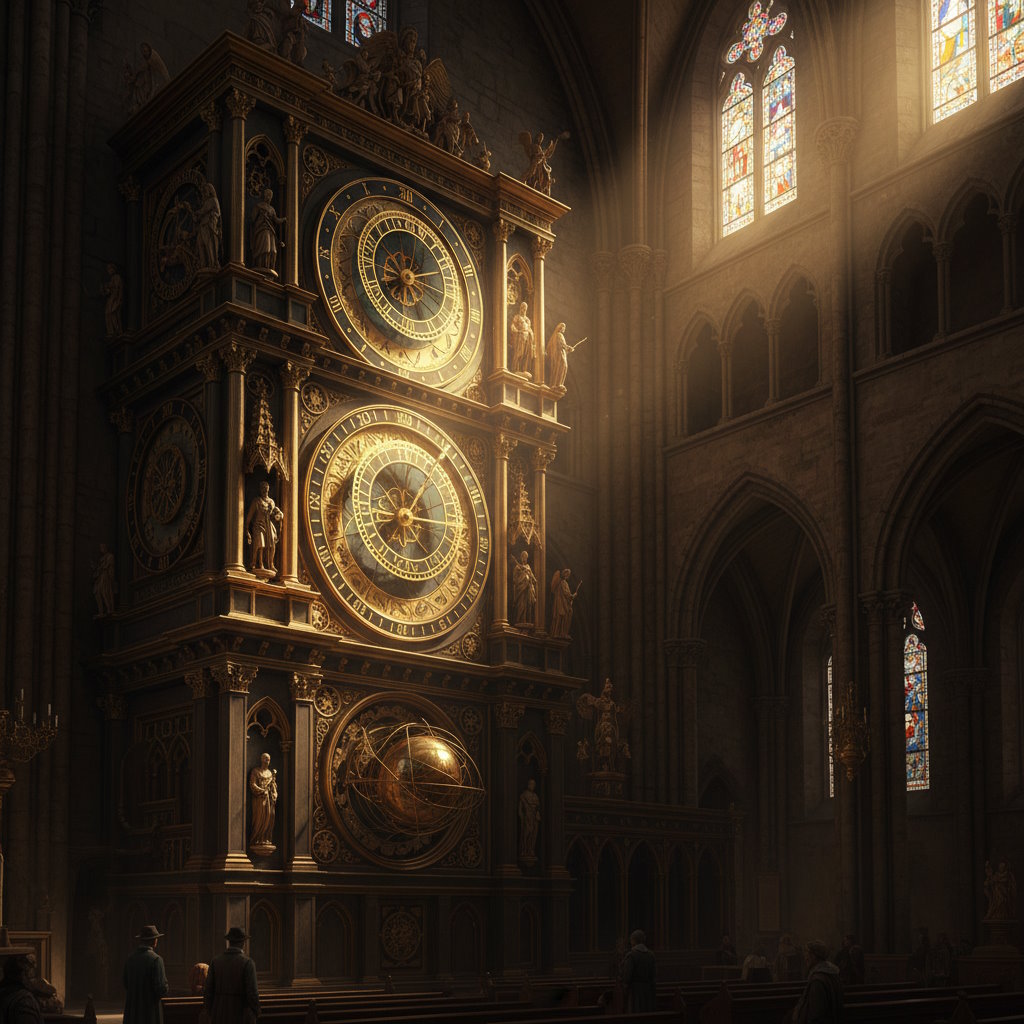
Inside the cathedral there is something worth standing in line for (and there is a line there, believe me). This is the Astronomical Clock. And this is not just a “cuckoo” that pops out once an hour. This is a real Renaissance computer!
The clock shows not only the time, but also the position of the planets, the signs of the zodiac, and the date of Easter (which, as we know, is difficult to calculate without half a liter of Alsatian wine). The most interesting performance starts at 12:30. The mechanism comes to life: a parade of apostles passes before the viewer, Christ bows, and a mechanical rooster crows and flaps its wings.
Imagine the level of engineering in the 16th-19th centuries! Masters from Switzerland and France put their whole souls into this mechanism. It reminds us that Europe has always been a place where science and faith went hand in hand, trying to explain the structure of the Universe. Today, when everyone has a smartphone in their pocket, these gears evoke almost childlike affection and deep respect.
Victor Hugo and Goethe: Fans From the Past
If it seems to you that admiring the cathedral is mainstream, then you are in good company. Young Goethe, as a student in Strasbourg, fell in love with Gothic architecture here. Before that, it was believed that Gothic was something barbaric and crude. But Goethe looked at the spire and said: “Guys, this is frozen music!” He even climbed to the very top of the tower to overcome his fear of heights.
And Victor Hugo called the cathedral a “gigantic and delicate miracle.” And this is perhaps the most accurate description. You look at this behemoth, and then you get closer and see thousands of small details: saints, demons, gargoyles, scenes from the Bible, carved with jeweler’s precision. This stone lace seems weightless, although it weighs thousands of tons.
A Modern Perspective: A Meeting Place for Europe
Today, Strasbourg is not just a beautiful city, it is a symbol of a united Europe. The European Parliament meets here, and the fate of the continent is decided here. And the cathedral stands in the middle of it all as a silent witness to history. In the context of today’s events, when millions of Ukrainians are forced to seek temporary homes in EU countries, Strasbourg Cathedral takes on a new, symbolic meaning. It has seen wars, destruction, changes of flags (the city passed from France to Germany and back four times in 75 years!), but it has stood firm.
For many Ukrainian refugees who have found themselves in France or neighboring Germany, visiting this place becomes a moment of silence and hope. Entering under its vaults, placing a candle somewhere in a side aisle, people feel eternity, which is above momentary tragedies. Here you can often hear Ukrainian speech – tourists and new residents of Europe come here for beauty and peace. The cathedral unites: Catholics, Protestants, agnostics, people from Kyiv, Lyon, Warsaw, or New York stand shoulder to shoulder here.
Tourist Life Hacks: How to Get the Most Out of It
- Climb the platform. Yes, it’s 332 steps on a spiral staircase. Yes, your legs will hurt. But the view from the top is worth it. On a clear day, you will see not only the tiled roofs of Strasbourg, but also the Black Forest in Germany, and even the Vosges. The whole world at your fingertips!
- Look in the evening. In the summer, stunning light shows are held on the facade of the cathedral. Music, projections, history coming to life on stone – it’s absolutely free and incredibly effective.
- Don’t forget about the surroundings. There are many souvenir shops around the cathedral. Don’t buy plastic magnets. It is better to take a real Alsatian gingerbread or a small ceramic mold for a “kouglof” cake. It will be warmer and more authentic.
Bottom line: Strasbourg Cathedral is a must see. This is not just a “checkmark” in the list of attractions. This is a place of power, where history meets modernity, and heavy stone turns into light lace, reaching for the sky. So, when planning your next Eurotrip, be sure to leave a day for Strasbourg. The pink giant will be waiting.